The reconstruction
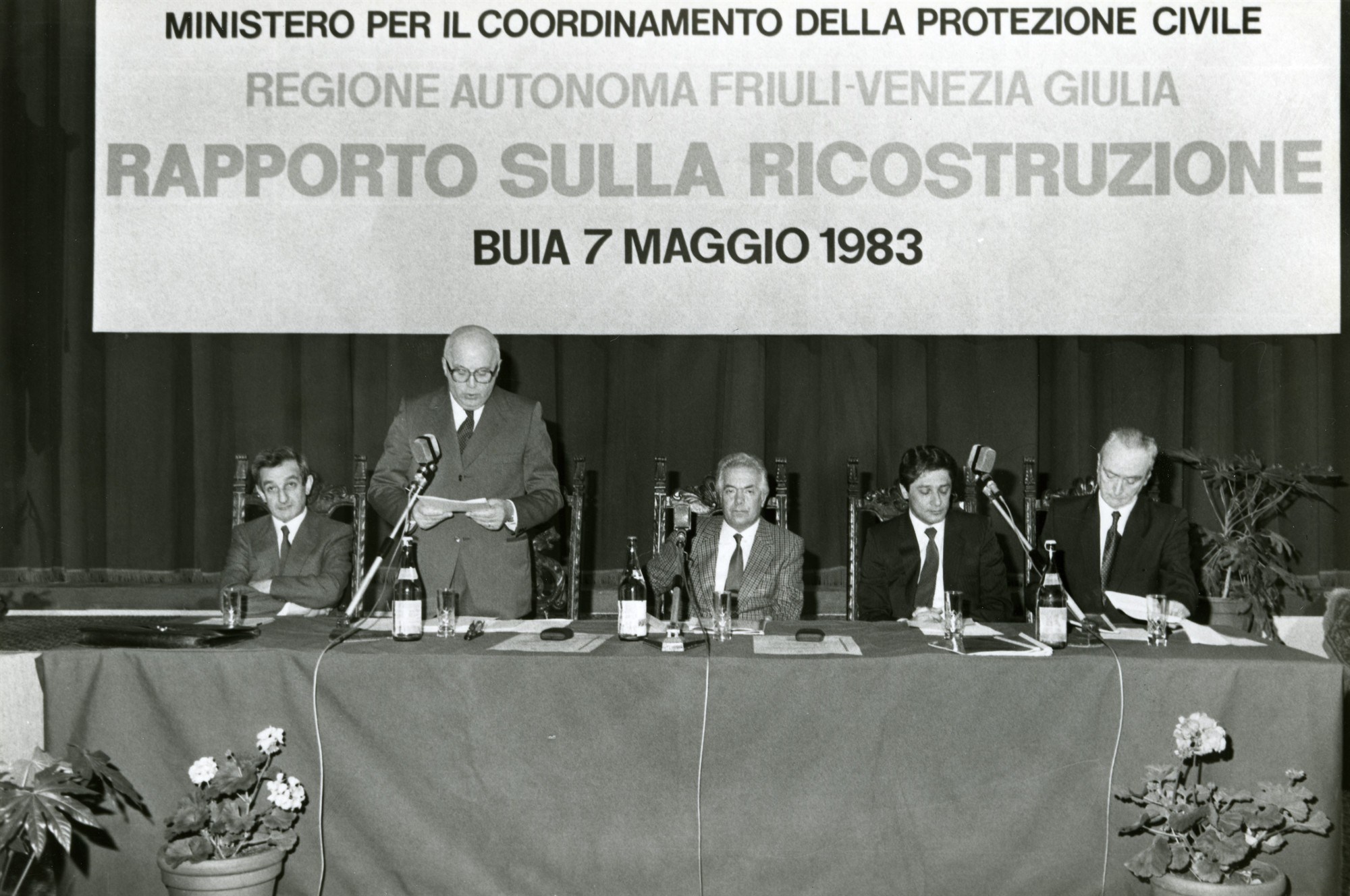
Enrico Pavonello, Biblioteca del Consiglio regionale FVG Livio Paladin
Convegno organizzato dalla Regione Autonoma F.V.G. e dal Ministero per il Coordinamento della Protezione Civile, dal titolo: "Rapporto sulla ricostruzione"
The
reconstruction of earthquake-stricken Friuli took about ten years to complete.
By the mid-1980s, virtually everyone whose home had been damaged or destroyed
was living in a new, safer building. There are no comparable examples of such
speed and effectiveness, at least in Italy, given the magnitude of the seismic
event and the affected area.
The ‘as it was, where it was’ principle
that guided this work was best exemplified by the reconstruction of historic
city centres that had been destroyed. In order to restore them, modern
anti-seismic techniques were employed, and the cooperation of all concerned
parties was necessary: the Municipal administrations, which had broad autonomy
in urban planning; architects, professionals and businesses, who mediated
between the inhabitants’ wishes and technical constraints; and finally, the
population itself, which contributed to the most important decisions in crowded
public assemblies. The towns of Gemona and Venzone are the best-known examples
of achieving this shared purpose, but it also came to fruition in Buja, Artegna
and other smaller towns and settlements.
The
system that was employed, which was based on the technical standardisation of
interventions and the on-site reconstruction of residential housing,
reduced the scope for stylistic and constructional variation. The result was a
strong uniformity of architectural language. ‘Modern’ styles found expression
in public and religious buildings, as well as factories and production sites.
Another
area in which collaboration between the private and public sectors was most
effective was the recovery and safeguarding of cultural heritage. This included
unprotected structures such as traditional dwellings, for which a specific
regulatory category of intervention was created, as well as a significant
number of artworks that were rescued, catalogued and studied for the first
time, paving the way for their future enhancement. Exhibitions and conferences
of international importance complemented this process, reinforcing the idea
that a territory and its population are also defined by their culture.