The debate
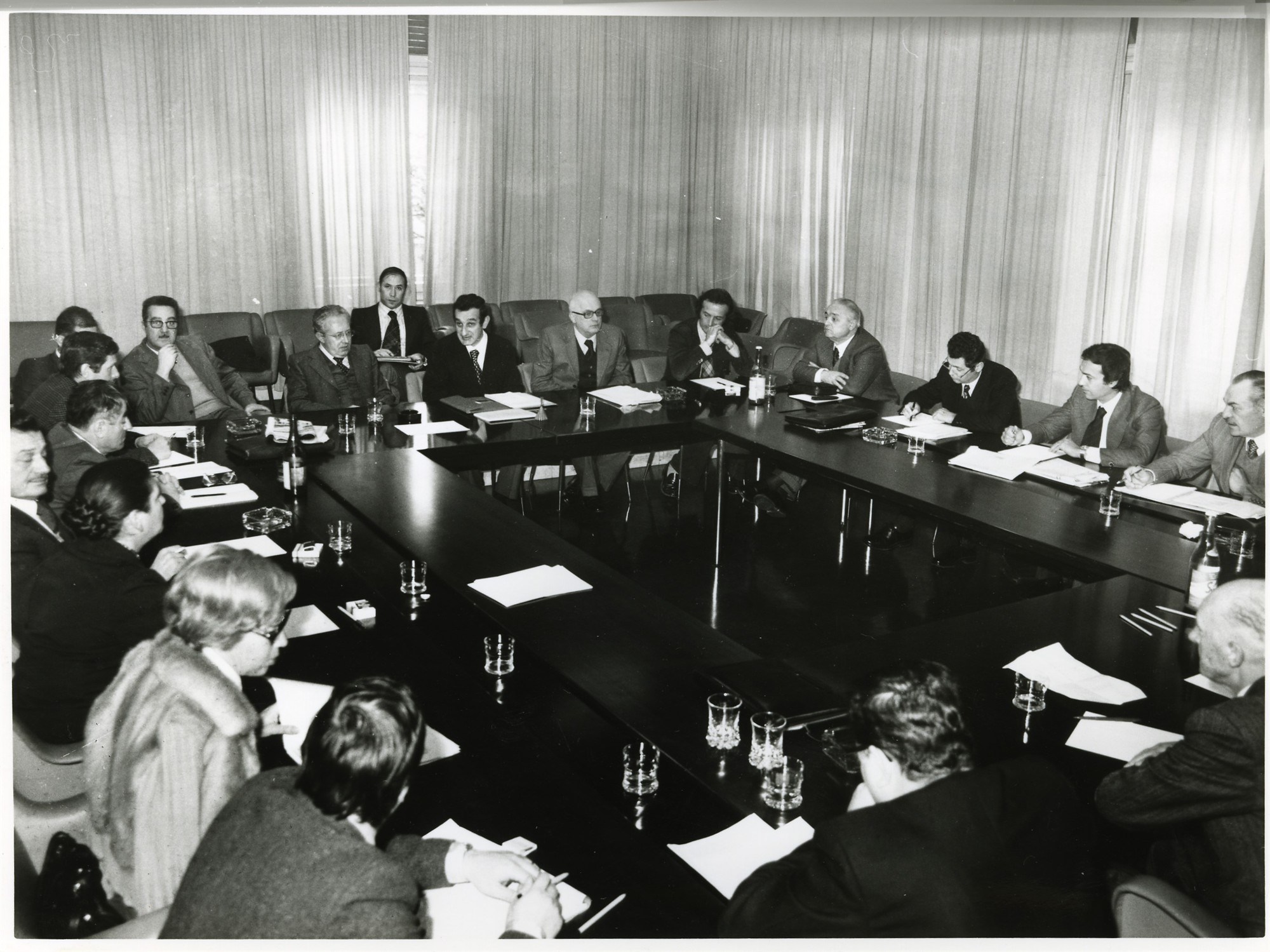
Enrico Pavonello, Biblioteca del Consiglio regionale FVG Livio Paladin
Riunione della Commissione Speciale per il terremoto, dicembre 1976
In the days
immediately following the tremor of May 6 1976, the Italian Prime Minister,
Aldo Moro, made a decision that would prove fundamental to the reconstruction: the
Autonomous Region of Friuli Venezia Giulia was granted a leading role. Unlike
other Italian regions with an ordinary statute, it had been granted special
autonomous powers around twelve years earlier. This meant that, even before the
earthquake emergency, it had already developed a functioning administrative
framework.
Discussion also
began at once on which direction to take, with politicians convinced from the
very outset that the aim should be ‘as it was, where it was’, while town planners
and architects believed that the reconstruction offered an opportunity to try
to imagine different solutions capable of going along with, if not
anticipating, the trends of economic and social modernisation.
In reality, the
debate over which philosophy to follow remained a purely theoretical
discussion. Both the tent-city population and the political class immediately
decided that the towns had to be rebuilt exactly where they had stood before
the tremors and that demolished houses, wherever possible, had to be rebuilt as
they had been before. While new materials and anti-seismic techniques were
accepted, every effort was made to save whatever could be saved. Only one new
town was built: Nuova Portis, in the Municipality of Venzone, as the
original village site was at risk of landslides.
The second event
that marked the beginning of the reconstruction process did not take place in
Rome, but at the seat of the Regional Government in Trieste. Informal
agreements were reached between the Christian Democrats (Democrazia Cristiana –
DC), the dominant political force in Friuli Venezia Giulia at that time, and
the opposition forces, primarily the Italian Communist Party (PCI). All the
political and cultural groups across the territory agreed to put aside their
differences and work together to achieve the rebirth of Friuli. This ‘seismic
compromise’ engaged everyone in the task of regenerating the
earthquake-stricken areas. Regional offices, local administrations, and mayors
were the driving force behind this endeavour.