The architecture of rebuilding: construction, industry and infrastructure
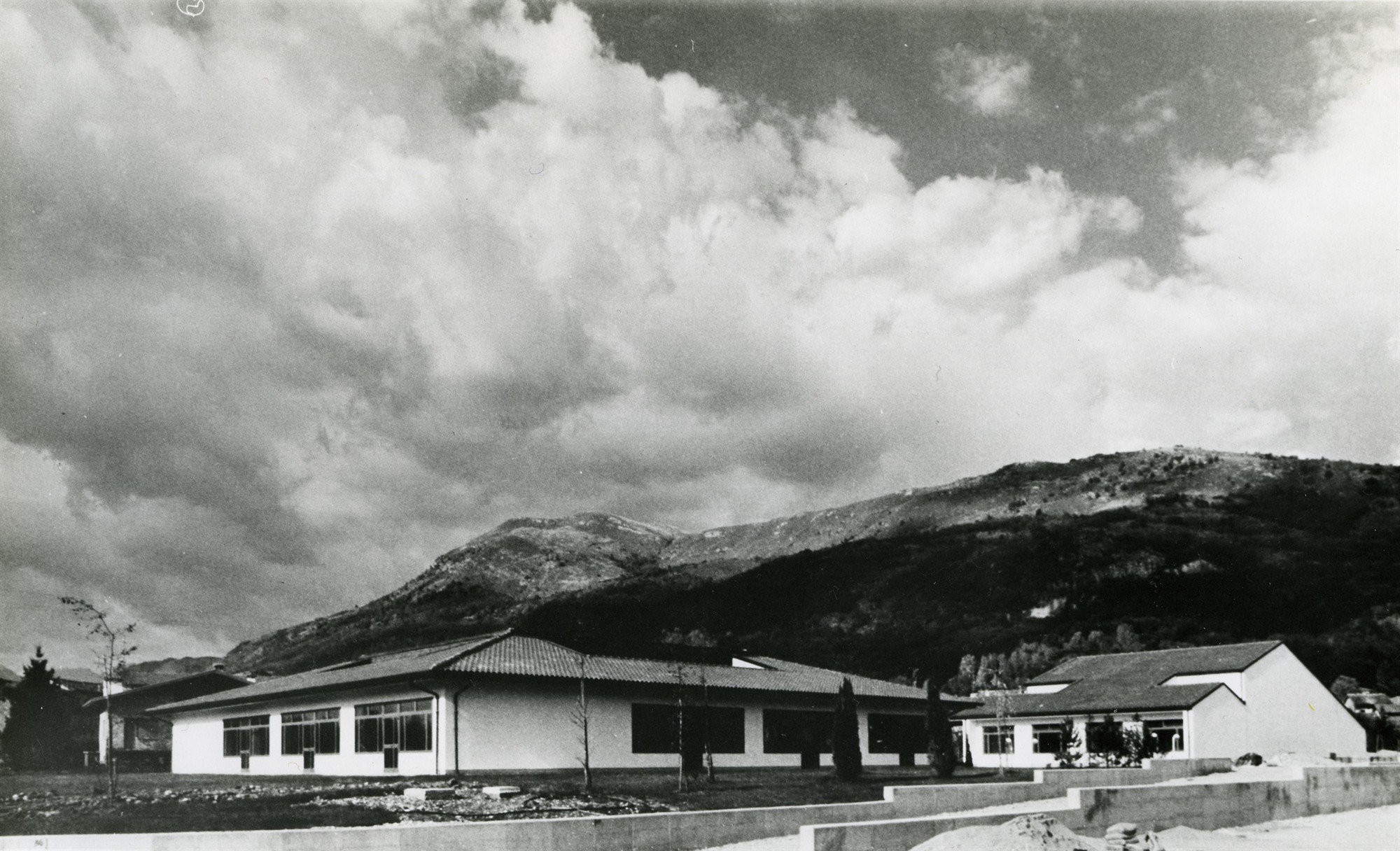
Studio Avon Architetti Associati
Gianni Avon, scuola di Travesio, 1977-80
Within ten years, the
reconstruction could be considered substantially complete. Speaking at the
conference ‘1976-1986: The Reconstruction of Friuli’, architectural historian
and critic Francesco Tentori was indeed able to present a comprehensive
evaluation. He said that the Friulian reconstruction had to be judged as an
extraordinary achievement: «Positive in how it managed to blend and engage the
most diverse forces, positive for the speed of the results, and positive for
the overall average quality it achieved».
Given the results
obtained in such a short time, especially compared to the ongoing
‘reconstruction with no end’ in the Belìce area, no other conclusion seems
possible. In Friuli, approximately 75,000 houses were repaired, and 16,000 were
rebuilt at an impressive rate. For buildings that had suffered light damage,
reconditioning took only three years, at a rate of around 10,000 dwellings per
year. However, the average rate for repairs was 5,000 buildings per year and
1,500 for new dwellings.
This extraordinary result
was made possible by an interconnected system of administrative, regulatory and
socio-cultural factors operating simultaneously, which has become known as the
‘Friuli Model’. From a strictly reconstructive perspective, the standardisation
of procedures and practices proved fundamental: the assessment of damage and
costs, design based on the Technical Documents, and building technologies that
could also be implemented by small firms, thereby making it possible to
accelerate the process. The objective was undoubtedly achieved, even if,
according to architecture scholars, at the cost of an ‘anonymous
reconstruction’ that in fact reproduced the pre-existing, at least in its
visible forms. While praising the results, Tentori himself observed that in the
Friulian reconstruction, the modern in architecture «emerged thoroughly
defeated by the false-traditional [language]».
In the
earthquake-stricken region of Friuli, modern architectural language is now
reflected above all in the symbols of the community: the town hall and the
church. However, restoration or faithful reconstruction of existing religious
buildings was not the preferred approach; such solutions were adopted even in
cases where the buildings were not extraordinary works of art, such as the
Cathedrals of Gemona or Venzone.
Data on the
reconstruction of the 1,192 churches in the Archdiocese of Udine provide a
significant illustration of the impact of the earthquake: 114 churches were
destroyed, and a further 234 were seriously damaged. An additional 484 places
of worship sustained minor damage. During that period, 41 bell towers were
demolished, and another 119 sustained more serious damage than the 164 that
were impacted only to a minor extent.
However, the result was
not always convincing among the new religious buildings; a case in point is the
fleeting expressionism on display in the Church of Santi Pietro e Paolo in Majano. However, there were many examples of fine ecclesiastical
architecture, including the Church of Sant'Elena in Montenars, designed by
Augusto Romano Burelli and Paola Gennaro; the Church of Portis Nuova,
designed by Emilio and Simonetta Daffarra; and the Church of San Giorgio in Lusevera, designed by Gianni, Elena and Giulio Avon.
New architectural trends
were more evident in the renovation or refurbishment of town halls; of the 45
municipal buildings damaged in the disaster, 23 were rebuilt, two more than the
21 that were repaired. In some cases, historic town halls were extended and
transformed, and even in these instances, the projects designed by the
architects Roberto Pirzio Biroli in Venzone and Giovanni Pietro Nimis in
Gemona, which were not without their critics, are still cited as benchmarks to
this day.
In new constructions, the languages of modernism and
postmodernism prevailed. The town halls of Cercivento and Montenars, designed
by Augusto Romano Burelli, whom Tentori would later award the «Oscar for
reconstruction», are among the most successful projects. Another notable
example is the town hall of Clauzetto, designed by Giuseppe Davanzo,
which is integrated into the historical fabric of the town at various
altimetric levels. According to Tentori, the designs for the town halls in Buja
by Giovanni Caprioglio and Alessandro Pertoldeo and in Osoppo by Luciano Semerani, Gigetta Tamaro and Adalberto Burelli were less successful. The
scholar also gave a negative review of the new town hall in Artegna, but did
not comment on the extension to the town hall in Sutrio, designed by Gino Valle, or the new town hall in Trasaghis, designed by Arnaldo Zuccato. Both
projects had been completed in the years preceding the earthquake.
The reconstruction of industrial plants was likewise
impressive. In Majano, the office building of the Snaidero company, considered
one of the symbols of Friulian ‘modernism’, required some structural
modifications. At the time of the earthquakes, the building was still under
construction and lacked the famous portholes for which it is known today, but
it continues to be a notable feature in photographs chronicling Majano after
the destruction. In just two years, two new buildings with metal structures were
converted into an exhibition and social services centre in the same industrial
area. These buildings were also designed by Angelo Mangiarotti. Another
exhibition building was designed by Alessandro Vittorio, who used distinctive
geometric forms to ensure it was eye-catching for passing motorists. While the
earthquake spared the service and office centre designed by Gino Valle at the
Fantoni factory in Rivoli di Osoppo, which was completed in 1975, it destroyed
the ‘Manifatture’ plant in Gemona. This was rebuilt in just one year following
a rational design signed by Udine-based architect Emilio Mattioni that
distinguished the production units from the service ones. The metal lattice
structures, alongside those in reinforced concrete, made the space extremely
flexible and easily expandable in the future.
The reconstruction of
Friuli was conceived by the lawmakers as a means of development. The process
was also characterised by the architecture of the viaducts on the
Udine-Tarvisio section of the motorway and the infrastructure on state highways
13 and 251. These were designed by Silvano Zorzi, one of the most renowned
structural engineers in Italy.
As part of the
modernisation of the Pontebbana railway, which was partly elevated to eliminate
level crossings, in the 1990s, Alberto Antonelli designed the new passenger
building at the station in Gemona.
It was in this context
that the aid guaranteed by the Vice President of the United States, Nelson
Rockefeller III, following his visit to Friuli, came into play. In a
short time, the US Congress allocated $25 million, approximately 21 billion
lire, disbursed by the United States Agency for International Development,
USAID. Between late May and early June, the programme director, Arturo Giovanni
Costantino, arrived in Friuli with a group of American experts and technicians
to utilise the funds. One million US dollars was allocated for the purchase of
medicines and emergency supplies, while the remaining $24 million was earmarked
for the construction of schools and elderly care facilities. Initially, the
planning of the projects involved the nursing homes in San Daniele, Majano,
Osoppo and Magnano in Riviera, and schools in Buja, Faedis, Gemona, Maniago,
Osoppo, San Daniele, Travesio and Majano.
Following the earthquakes
in September, the US Congress allocated a further $25 million, to which it
added an additional $3 million to compensate for damage in the province of
Pordenone, home to the US air base at Aviano. The second programme, funded by the
$55 million allocated by the United States, equivalent to around €200 million
today, involved constructing five schools in Aviano, Cividale, Maniago, Sacile
and Spilimbergo; three centres for the elderly in Buja, Pordenone and Villa
Santina; and a student residence in San Pietro al Natisone. The US authorities
decided that the funds would be allocated directly to the National Alpini
Association (Associazione Nazionale Alpini - ANA) for management, while the
construction work would be entrusted to the Italian branch of the American
engineering firm The Austin Company.
All of the projects,
which were assigned to Italian and US professionals, had to adhere to the «most
recent American anti-seismic design concepts». The selection process was highly
competitive, with the firms Mitchell/Giurgola (Romaldo Giurgola in association
with Ehrman B. Mitchell) and Renato Severino with Sergio Alessiani being
chosen. Other professionals invited to submit proposals included Gianni Avon,
the only professional from Friuli, and architects Marco Zanuso, Giancarlo De Carlo, Fausto Colombo, Vico Magistretti, Umberto Riva and Luisa Anversa, all
from Milan. Although the designers were granted maximum freedom, they were
asked to adopt a traditional style that was respectful of Friulian
architecture.
Among the notable
architectural projects, the works of Gino Valle deserve recognition,
particularly the social housing district in Buja, financed by the
Industrialists' Association, and the reconstruction of the urban landscape in
Santo Stefano di Buja and Gemona. Across from the district designed by Valle in
Gemona stand the Banca Popolare offices, which were initially designed by Carlo Scarpa and later completed following his death by Luciano Gemin. Although
Scarpa was originally commissioned to rebuild the bank on a larger site, he was
nevertheless not constrained by any limitations. He decided to restore the
original structure of the destroyed Pontotti Palace, complete with its pitched
roof, and complement it by adjoining a structure characterised by large skylights.
Redazione, Industrie, in
«Ricostruire», 5 (1978), pp. 75-101; Redazione, Ricostruzione A.I.D.,
in «Ricostruire», 5 (1978), pp. 33-67; Angelo Mangiarotti: Ricostruzione in
Friuli, in «Domus», 587 (1978), pp. 14-21; Angelo Mangiarotti: Nel
Friuli uffici di campagna, in «Domus», 591 (1979), pp. 10-15; G. Caprioglio
- A. Pertoldeo - S. Langè - G. Valle - F. Marconi - V. Zanfagnini - E. Pascolo
- G. Vacchiaro, Piani particolareggiati nel Comune di Buia, in
«Ricostruire», 8/9 (1979), pp. 33-36; P. Gennaro, I municipi di Montenars e
Cercivento, in «Ricostruire», 10/11 (1980), pp. 53-57; G. Valle, Ambito
edilizio unitario, in «Ricostruire», 13/14 (1980), pp. 21-23; F. Colombo, Cinque
anni dopo: le scuole finanziate dagli USA nel Friuli terremotato. La prima fase
di attuazione, in «Edilizia scolastica», 17-18 (1981), pp. 25-29: O.
Colacicco, Il programma di intervento dell’AID (USA) per il Friuli
terremotato, in «Edilizia scolastica», 17-18 (1981), pp. 29-30: M. Prizzon,
Otto risposte all’emergenza, in «Edilizia scolastica», 17-18 (1981),
pp.32-78: E. D. Bona - F. Colombo, Servizi sociali ed esposizione Snaidero a
Majano del Friuli, in «L’architettura. Cronache e storia», 320 (1982), pp.
442-451; G. Celiberti, Tre interventi industriali in Friuli, architetto
Alessandro Vittorio, in «L’architettura. Cronache e storia», 320 (1982),
pp. 390-403; F. Colombo, La manifattura di Gemona, in «L’architettura.
Cronache e storia», 321 (1982), pp. 524-533; D. Brenner, Made in
Friuli. Five projects in Friuli by Mitchell/Giurgola Architects and Renato
Severino Architects & Planners, in «Architectural Record», 8 (1983),
pp. 104-117; E. B. Mitchell - R. Giurgola, Mitchell/Giurgola
architects, New York, Rizzoli int. 1983; G. Marcialis, Appunti dal libro
della ricostruzione, in «Casa Vogue», 139 (1983), pp. 212-225; F. Tentori, Le
architetture della ricostruzione, in S. Fabbro (a cura di), 1976-1986 La
ricostruzione del Friuli, Atti del convegno (Udine 21-22 marzo 1986),
Udine, Ires 1986, pp, 96-100; G. Mazzariol (a cura di), Banca popolare di
Gemona. Luciano Gemin architetto, Treviso, Vianello 1986; F. Dal Co - G.
Mazzariol, Carlo Scarpa. 1906-1978, Milano, Electa 1987; L. Rossi, Giancarlo
De Carlo. Architetture, Milano, A. Mondadori 1988; P. A. Croset, Gino
Valle. Progetti e architetture, Milano, Electa 1989; M. Castagnara Codeluppi, Quarant’anni di attività
edilizia in Friuli, Udine, Arti grafiche friulane 1989; S. Polano, Guida
all’architettura italiana del Novecento, Milano, Electa 1991; M. Vasciaveo,
Il terremoto del '76, in S. Polano - L. Semerani (a cura di), Friuli
Venezia Giulia - guida critica all'architettura contemporanea, Venezia,
Arsenale 1992, pp. 175-180; L. Di Sopra, Il costo dei terremoti,
Tricesimo, Aviani 1992; M. Bortolotti, Americani in Friuli. La solidarietà
nel nome dell’architettura, in «Rassegna Tecnica del Friuli Venezia
Giulia», 6 (1995), pp. 25-28; G. Dri, Il centro scolastico di Faedis, in
«Rassegna Tecnica del Friuli Venezia Giulia», 6 (1995), pp. 28-30; W. Bigatton
- M. Bordugo - G. Lutman - S. Moranduzzo, 1945-1995. Architettura nel Friuli
Occidentale, Pordenone, Biblioteca dell’immagine 1995; M. Pozzetto (a cura
di), Guida all'architettura del Novecento di Udine e provincia, Electa,
Milano 1996; F. Luppi - G. Zucconi (a cura di), Gianni
Avon. Architetture e progetti 1947-1997, Marsilio, Venezia 2000; P.
Bon - G. Vragnaz, Architettura in Friuli: la ricostruzione anonima, in «Parametro», 251 (2004), pp. 62-67; M. Antico (a cura
di), Giuseppe Davanzo. Il mestiere dell’architetto, Milano, Skira 2005; P.
A. Croset L. - Skansi, Gino Valle, Milano, Electa 2010; A. Indrigo - N. Indrigo - G.C. Custoza (a cura di), Opere
aperte. Ripensare e riconnettere il costruito – 35 anni dopo. Problemi e
soluzioni, Milano-Udine, Mimesis 2011; S. Piussi - D. Omenetto, Cjase
di Diu cjase nestre. Chiese prima e dopo il terremoto in Friuli, Atti dei
convegni (Udine, 11 marzo 2011; 22-23 giugno 2012), Udine, Arcidiocesi 2013; R.
Severino, Building in the western hemisphere. 1959-1989, Firenze,
Altralinea 2016; Renato Severino architetto in quattro continenti,
Catalogo della mostra (Firenze, 5-30 giugno 2018), Firenze, Polistampa 2018; C.
Semenzin, L’altra modernità della ricostruzione del Friuli, in «Officina», 36 (2022), pp. 42-47; F. Irace (a cura di), Angelo
Mangiarotti. Quando le strutture prendono forma, Catalogo della mostra
(Milano, 27 gennaio-23 aprile 2023), Milano, Electa 2023; A. Capuano, Luisa
Anversa, Siracusa, Lettera Ventidue 2024; M. Gemin (a cura di), Luciano
Gemin architetto, Venezia, Lineadacqua 2025; D. Barillari - P. Valle (a
cura di), Architettura del Novecento a Gemona e nella Pedemontana friulana,
Catalogo della mostra (Gemona del Friuli, Palazzo Fantoni, 11 dicembre 2025-21
giugno 2026), Udine, Forum 2025.