The cultural heritage
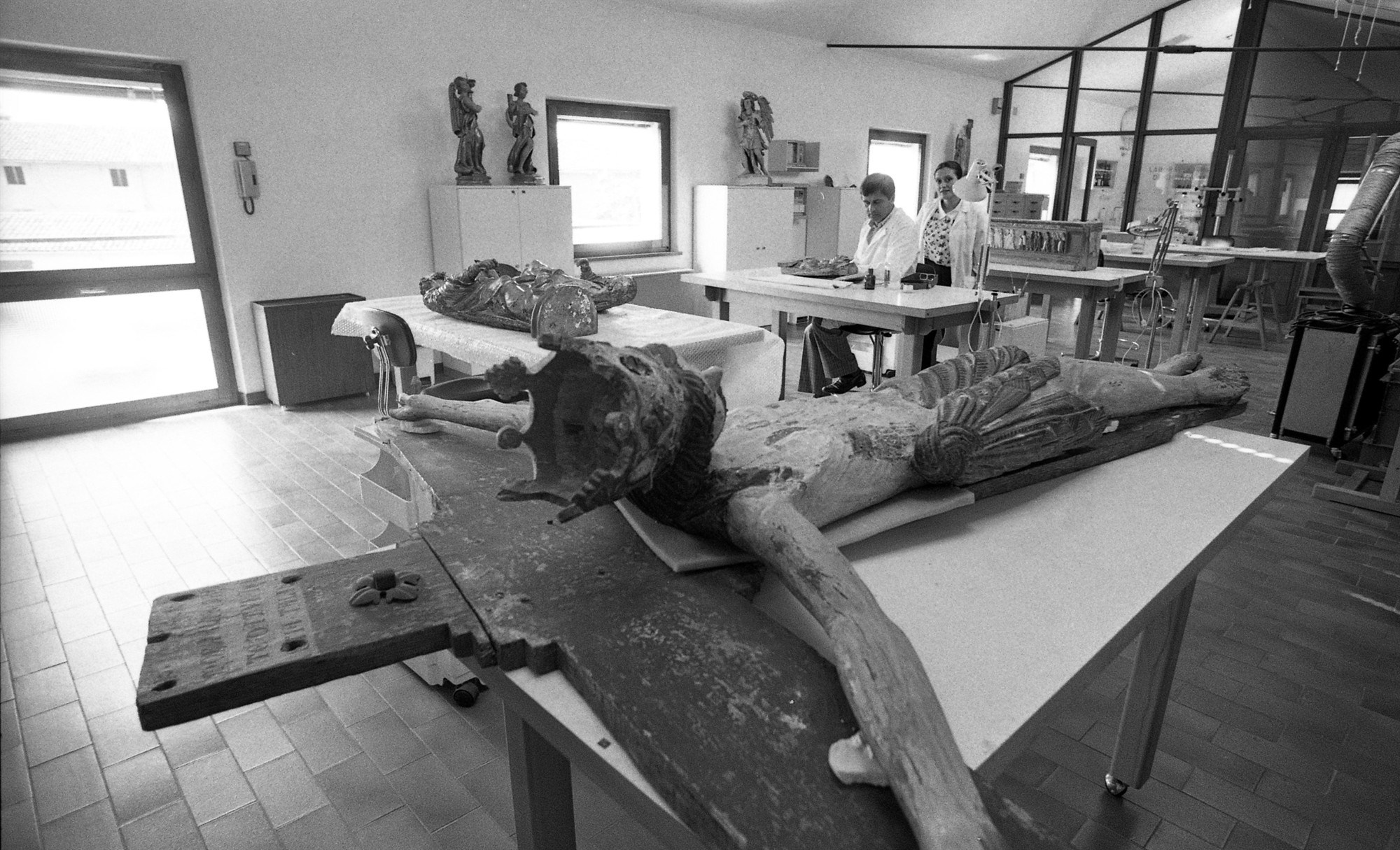
Renato Rizzo, Biblioteca del Consiglio regionale FVG Livio Paladin
Documentazione dei lavori del Laboratorio di Restauro di Villa Manin, 1987
Following the earthquake in May, the
urgent need to safeguard the damaged historical and artistic heritage and
prevent any possible subsequent dispersal became clear. Just a few days after
the first tremor, Gian Carlo Menis, the director of the Diocesan Museum of
Sacred Art in Udine, set up a collection and restoration hub in the church of
San Francesco in Udine, in collaboration with Mayor Candolini. The first item
to arrive at the centre, on May 14, was a wooden altarpiece salvaged from the
rubble of the cathedral in Gemona, one of the Municipalities that were worst
affected by the earthquake. The artefacts, which were recovered by teams of
volunteers, were photographed by students from the ‘G. Sello’ Art Institute in
Udine, and inventoried by several scholars, including Luciano Perissinotto and
Luciana Marioni Bros (here's an interview). The latter recalled the months spent inside the church,
and the support received from the local authorities, in December 1976: «There
was sincere commitment on the part of many mayors and parish priests to save
what could be saved». Approximately 1,500 items were collected.
Alongside this initiative, defined by the
then Minister for Cultural Heritage, Mario Pedini, who arrived on a visit in
July 1976, as «an important contribution to the reconstruction», the Regional
Council also took action in May to establish, still in Udine but at Via Manzini
35, a second Collection Centre for artworks and for the safeguarding of
cultural and environmental heritage, the coordination of which was entrusted
once again to Gian Carlo Menis.
To
facilitate the organisation of the activities for salvaging and transporting
the works, the area affected by the earthquake was subdivided into eight
intervention zones comprising several Municipalities, each assigned to cultural
heritage experts, some of whom came from outside the Region: the zone of Gemona
(Luigi Menegazzi), Artegna (Giuliana Ericani), Osoppo (Roberto Baldissera), San
Daniele del Friuli (Giuseppe Bergamini), Tarcento (Mirabella Roberti and Sandro
Piussi), Moggio (Pietro Marchesi and Anna Serra Nigro), Carnia (Franco Quai)
and Pordenone (Antonio Forniz and Giuseppe Maria Pilo). Other collection
centres were set up in the Seminary on the Viale Ungheria in Udine, in the
Civic Museum of Pordenone and in the premises of the Palazzo Campeis building
in Tolmezzo. The commitment of the Diocesan Museum and the Region was joined,
firstly, by the initiative of the individual municipalities, including Venzone,
where Remo Cacitti set up a local committee and a depot in the Alpini barracks,
used until September 15; secondly, in Rome, the creation in June 1976, by
Decree of the Italian Minister for Cultural and Environmental Heritage, of a
‘Joint Committee for the coordination of the interventions on the cultural
heritage of the Friuli Venezia Giulia Region hit by the earthquake in May 1976’
with the function of liaising and coordinating the interventions.
With
the organisational machine set up to secure the damaged works, local
institutions began to consider how to plan the processes necessary to ensure
their preservation.
Even
before a temporary restoration laboratory for wooden artefacts, donated by the
Autonomous Province of Trento and the Federal State of Bavaria, was set up in
the Church of San Francesco in early October 1976, the Regional administration
had intervened to expand the functions of the Cataloguing Centre at Villa Manin
in the Municipality of Passariano, which had been provided for by Regional Law
No. 27 dated July 21 1971. With Regional Law No. 43 dated August 16 1976, the
tasks of the Centre were modified, assigning it the project of compiling and
updating the catalogue of cultural heritage and promoting restoration, so that
on December 7 of the same year, the Centre was finally established. On March 22
1977, under the supervision of Marioni Bros, the first four-year course was
launched, with theoretical study and practical exercises. Regional Law No. 60 dated November 18 1976, was another decisive measure concerning restoration.
Issued after the September tremors, it was designed to finance work for the conservation,
restoration and enhancement of movable assets considered to be of artistic,
historical and archaeological interest.
The State Superintendency office took
action in the area of wall paintings and immovable heritage. In the initial
phase, it surveyed works in the towns of the seismic crater, shoring up
numerous historic buildings and detaching frescoes from collapsing walls to
place them on temporary panels. Once the emergency had passed and the extent of
the damage had been determined, the State allocated 100 billion lire to the
Superintendency for a five-year period, from 1977 to 1981, through Italian Law
No. 546 dated August 8 1977. Although the contribution was substantial, the
restorations, which were coordinated by the superintendents and architects
Riccardo Mola and Pietro Scurati, proceeded slowly. In 1976, the management of
cultural heritage was inadequate. Following the earthquake, the Office of the
Superintendency for Cultural Heritage in Udine was established, but with
insufficient staff to manage the emergency. This initial phase of disorder was
noted not only by the Diocesan Pastoral Council, which, on November 18 1978,
expressed its disapproval in the document The reconstruction and rebirth ofthe earthquake-stricken areas of Friuli: «The situation also appears
gravely deficient with regard to the matter of cultural heritage. The
extraordinary allocation of 100 billion […] risks dissolving into a disordered
shower of uncoordinated interventions, lacking any overall plan referring to
the reality of the earthquake-stricken areas.» Cacitti, conversely, had done
what was possible in Venzone from the very first hours after the earthquake;
this was long before the publication of Le pietre dello scandalo, the
white paper on cultural heritage policy in earthquake-stricken Friuli, in 1980.
This work was written in collaboration with a group of intellectuals active at
a national level.
A change of direction had to wait until
January 1 1981, when Gino Pavan took over the leadership of the
Superintendency. His commitment to the recovery of cultural heritage was
crucial, so much so that he is remembered as one of the main architects of the
‘artistic reconstruction’ of Friuli. At the end of his term, in January 1986,
670 artistic assets had been restored, and 301 architectural works recovered.
The
Superintendency oversaw hundreds of restoration projects throughout the
earthquake-stricken area. Among the most complex interventions were the
restorations of the Castle of Udine, the Cathedral in Gemona (reopened for
religious functions in January 1986), the walls and the reconstruction of the
Cathedral in Venzone, which reopened its doors to its citizens on August 3
1995. The restoration specialists of the Superintendency also recovered many
cycles of frescoes, such as the fifteenth-century decoration in the small
church of Santo Stefano in Artegna, a masterful example of on-site
detachment and relocation.
These measures excluded all buildings that
were not classified as «of artistic or historical interest» under National Law
No. 1089 dated June 1 1939. A shift in approach came with Regional Law No. 30 dated June 20 1977, which aimed to re-evaluate this part of the cultural
heritage of Friuli. Article 8 of this legislation recognised that certain local
buildings possessed «environmental, historical, cultural and ethnic values»,
qualifying them for restoration. Following reports from the relevant local
authorities, the Regional Department for Environmental and Cultural Heritage
was tasked with compiling a list of « buildings, including those not used for
residential purposes, that were damaged by seismic events and represent stated
values». This list was created by recording and cataloguing all submitted
information, which was then assessed and approved by the Regional Council. As a
result, over 1,500 examples of rural and vernacular architecture in Friuli were
restored or rebuilt, receiving the same level of protection as properties that
qualified as cultural heritage under the legal definition.
In
addition to safeguarding the heritage, there was a fear that all the artefacts
would be removed from their original context. It was therefore vital that, once
restored, they all returned to their rightful places, wherever possible.
Giuseppe Bergamini, the current director of the Diocesan Museum, articulated
this concern, stating that «the works of our land [...] had meaning; they had
their own validity precisely because they were embedded in ongoing contexts
that continue to resonate with our people to this day». Therefore, it became
essential not only to rebuild individual houses and churches and restore
individual works, but also to «recreate the environment, a human environment
and a Friulian environment, for which all this had been created». Most of the
artefacts were returned to their original locations, while the more fragile
pieces, or those from completely collapsed buildings, were housed in the
Diocesan Museum in Udine.
In
this context, efforts were made to raise awareness among the communities
affected by the earthquake, so that, amidst collapsed houses and the injured,
concern for monuments and works of art would not be seen as ‘marginal’. To this
end, exhibits, debates and conferences were held in Friuli. Among these were
the ‘Conference on the problems of reconstructing the historical and artistic
heritage of Friuli and the restoration of historic centres’, held in Cividale
del Friuli on November 21 1976, and a series of lectures in Trieste, in 1977,
entitled ‘Friuli May 6 1976’, in which Menis, from the perspective of a
reconstruction focused on the people of Friuli, emphasised that «the most
urgent restoration must be that of the community itself; in other words, we
must rebuild the human fabric in areas that have been devastated».
There
was also a series of exhibitions focusing on art history. First and foremost
was ‘Masterpieces of art in Friuli. A culture to be saved’, curated by Aldo Rizzi, the Director of the Municipal Museums of Udine, and staged at Villa
Manin from September 5 to December 31 1976. This was followed in May 1977 by
‘Friaul lebt - 2000 Jahre Kultur im Herzen Europas (Friuli lives - 2000 years
of civilisation in the heart of Europe)’, a travelling exhibition conceived by
the archbishops of Vienna and Udine, which toured various locations in Austria
for a year with the dual aim of raising funds for the restoration of sacred
monuments and showcasing the artistic ties between Austria and Friuli
Another major exhibition, held in over
twenty towns and cities with Friulian communities in Europe and America, was
‘Friulian culture: past and present’, which opened at Villa Manin in Passariano
on May 10 1980. This venue also hosted the ‘Exhibition of wooden sculpture in
Friuli’ in 1983, which focused on heritage assets severely affected by the
earthquake. Another notable exhibition held there was ‘Friuli Reconstruction
1976–1986’. Organised in 1986 by the Extraordinary General Secretariat in
collaboration with the Regional Government, it provided an overview of the
initiatives that contributed to the rebirth of Friuli over the course of ten
years.
The underlying idea, which took shape in
the preservation and restoration of the historical, artistic and architectural
heritage of Friuli, stemmed from the belief, as Remo Cacitti wrote, that «no
people can survive for long without the enduring memory of their past».
G. Bergamini, Un patrimonio artistico irrimediabilmente
compromesso, in «Il Punto», 9 (15 maggio 1976), pp. 53-54; G. Bergamini, Considerazioni
dell’arte friulana dopo il 6 maggio, in «Quaderni della FACE», 48
(gennaio-giugno 1976), pp. 6-13; G. Bergamini, Danni al patrimonio
artistico del Friuli, in «Sot la Nape», XXVIII/2-3 (1976), pp. 45-53; L. Marioni Bros, Esperienze di
cinque mesi nella chiesa di S. Francesco, in «La Panarie», 33-34/9
(dicembre 1976), pp. 11-17; A. Rizzi (a cura di), Capolavori d'arte
in Friuli. Una cultura da salvare, catalogo della mostra (villa Manin di
Passariano, 5 settembre-31 dicembre 1976), Milano, Electa 1977; G. Bergamini, La
cultura di una terra, in «La Vita Cattolica» (7 maggio 1977), p. 11; R.
Cacitti, Il patrimonio di una gente, in «La Vita Cattolica» (7 maggio
1977), pp. 8-9; Atti del Convegno sui problemi della ricostruzione del
patrimonio storico-culturale del Friuli e sul recupero dei centri storici,
atti del convegno (Cividale, 21 novembre 1976), Udine, Arti Grafiche Friulane
1977; Friuli 6 maggio 1976. Ciclo di conferenze sul Friuli devastato dal
terremoto, atti del convegno (Trieste, 11 gennaio-5 aprile 1977), Trieste,
Villaggio del fanciullo 1977; I cristiani per la ricostruzione e la
rinascita del Friuli, atti dell’assemblea (Udine, 17-19 giugno 1977),
Udine, Arti Grafiche Friulane 1977; A. Battisti, Friaul: ein beispiel
christlicher solidarität in katastrophenfällen. Friuli: un esempio di
solidarietà cristiana nei casi di catastrofe, Udine, Arti Grafiche Friulane
1978; G.C. Menis - A. Rizzi, Friaul Lebt. 2000 Jahre Kultur im Herzen
Europas, catalogo della mostra, Vienna, Herder 1978; Dalla tragedia una
speranza. La chiesa nel terremoto in Friuli, «La Vita Cattolica», 12 (marzo
1978); Il Friuli guarda al futuro, 6 maggio 1976-6 maggio 1978, «Regione
cronache Friuli-Venezia Giulia», 97 (4-5 maggio 1978); G. Bergamini, Tutela,
recupero e promozione del patrimonio artistico friulano, Udine, Arti
Grafiche Friulane 1979; Il recupero di un capolavoro di Pomponio Amalteo,
Milano, Electa 1979; G. Bergamini (a cura di), Civiltà friulana di ieri e di
oggi, catalogo della mostra (villa Manin di Passariano, 10 maggio-31
ottobre 1980), Udine, Società Filologica Friulana-Regione Autonoma Friuli
Venezia Giulia 1980; L. Marioni Bros (a cura di), 12 quadri di Ampezzo e
Oltris restaurati dopo il terremoto, catalogo della mostra (Passariano di
Codroipo, 1980), Passariano di Codroipo, Centro regionale di catalogazione e
restauro 1980; Cjase di Diu, cjase nestre. Problemi di arte sacra in Friuli
dopo il terremoto, atti del convegno (Udine, 22-24 giugno 1979), 1980; Le
pietre dello scandalo. La politica dei beni culturali nel Friuli del terremoto,
Torino, Einaudi 1980; A. Rizzi, Mostra della scultura lignea in Friuli,
catalogo della mostra (villa Manin di Passariano, 18 giugno-31 ottobre 1983),
Udine, Istituto per l'enciclopedia del Friuli Venezia Giulia 1983; G. Pavan, La
conservazione dei beni storico-artistici dopo il terremoto del Friuli
(1976-1981), Trieste, Villaggio del fanciullo 1983; La conservazione dei
beni storico-artistici dopo il terremoto del Friuli (1976-1981), vol. 3,
Trieste, Villaggio del fanciullo 1983; A. Bellina, L'anastilosi nella
ricostruzione del Friuli. Limiti e modi del restauro per anastilosi in alcune
applicazioni a Gemona e Venzone dopo il sisma del 1976, Venzone,
Associazione Amici di Venzone 1986; La conservazione dei beni
storico-artistici dopo il terremoto del Friuli (1982-1985), vol. 5,
Trieste, Editoriale libraria 1986; L. Marioni Bros, Il centro regionale di
catalogazione e restauro, in Enciclopedia monografica del Friuli Venezia
Giulia. Aggiornamenti 1978-1986, Udine, Istituto per l'Enciclopedia del
Friuli-Venezia Giulia 1987, pp. 493-506; G.C. Menis (a cura di), Un museo
nel terremoto. L'intervento del Museo diocesano di Udine a favore dei beni
culturali mobili coinvolti nel terremoto del 1976, Udine, Museo diocesano
d’arte sacra 1988; Friuli ricostruzione 1976-1986, Udine, Arti Grafiche
Friulane 1988; “Haec vasa tolle...”. Mostra del patrimonio artistico sacro
restaurato, catalogo della mostra, Udine, Arti Grafiche Friulane 1992; F.
Doglioni - A. Moretti - V. Petrini, Le chiese e il terremoto. Dalla
vulnerabilità constatata nel terremoto del Friuli al miglioramento antisismico
nel restauro, verso una politica di prevenzione, Trieste, Lint 1994; L'esperienza
legislativa di una tragedia a vent'anni dal terremoto del Friuli, Trieste,
Regione Autonoma Friuli Venezia Giulia 1996; G. Bergamini, L’antico a nuovo,
piccoli capolavori restaurati 1993-2000, catalogo della mostra (Udine,
chiesa di San Francesco, 11 maggio-1 luglio 2001), Pasian di Prato, Editrice
Leonardo 2001; G.C. Menis - L. Marioni Bros (a cura di), Il restauro come
atto di fede, catalogo della mostra (Udine, Museo Diocesano e gallerie del
Tiepolo, 2001), Udine, Museo Diocesano e Gallerie del Tiepolo 2001; G.
Bergamini, Fondazione Cassa di Risparmio di Udine e Pordenone, dieci anni
1992-2201 nel segno dell’arte, Udine, Fondazione Cassa di Risparmio di
Udine e Pordenone 2003; G. Bergamini - L. Marioni Bros (a cura di), Capolavori
salvati. Arte sacra 1976-2006. Trent’anni di restauri, catalogo della
mostra (Udine, chiesa di Sant’Antonio Abate e palazzo Patriarcale, 22
settembre-31 dicembre 2006), Udine, Museo Diocesano e Gallerie del Tiepolo
2006; A. Giacomello, Il Centro regionale di catalogazione e restauro dei
beni culturali del Friuli Venezia Giulia, in A. Vianello - F. Vicario (a
cura di), Codroip. 85n Congrès, atti del congresso (Codroipo, 5 ottobre
2008), Udine, Società Filologica Friulana 2008, pp. 265-271; R. Gentilli - G.
Croatto, Il patrimonio salvato. Il recupero dell’architettura spontanea
friulana dopo gli eventi sismici del 1976, Udine, Forum 2008; S. Piussi -
D. Omenetto, Cjase di Diu cjase nestre. Chiese prima e dopo il terremoto in
Friuli, Atti dei convegni (Udine, 11 marzo 2011; 22-23 giugno 2012), Udine,
Arcidiocesi 2013; C. Azzolini - A. Giusa (a cura di), Memorie. Arte,
immagini e parole del terremoto in Friuli, catalogo della mostra (villa
Manin di Passariano, 24 aprile-3 luglio 2016), Milano, Skira 2016; C. Azzollini
- G. Carbonara (a cura di), Ricostruire la memoria. Il patrimonio culturale
del Friuli a quarant'anni dal terremoto, atti del convegno (Udine, 11-12
maggio 2016), Udine, Forum 2016; D. Nobile - P. Pastres (a cura di), Dalla
polvere la luce. Arte sacra nel terremoto 1976-2016, Udine, Deputazione di
Storia Patria per il Friuli, Museo Diocesano e Gallerie del Tiepolo 2016; Gino
Pavan 1921-2017, atti del convegno (Trieste, 1-2 dicembre 2022), Trieste,
Archeografo Triestino 2023.