Securing works and demolitions
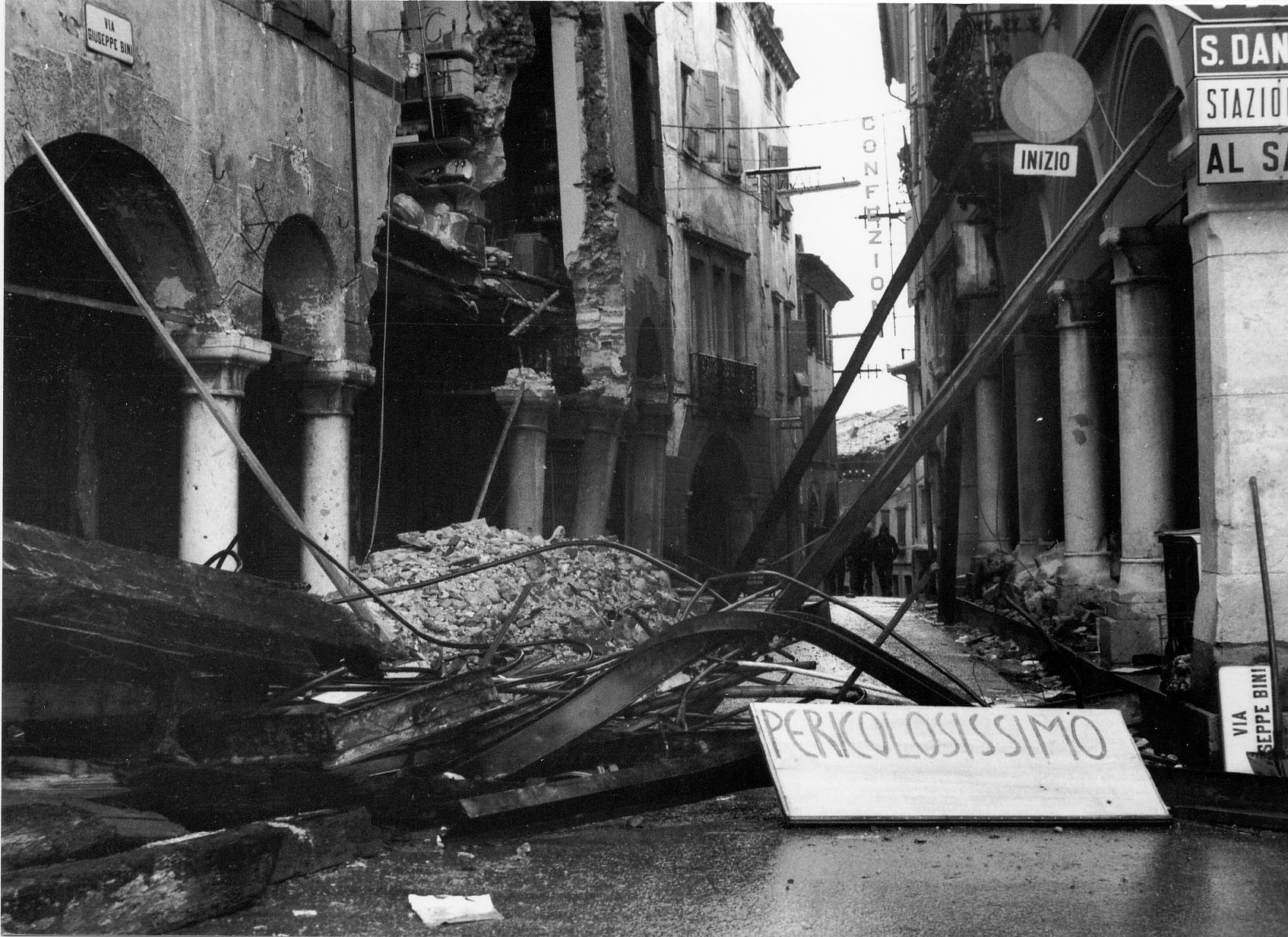
Centro documentazione video del Comando Provinciale VVF Udine
A few days
after the disaster, the government of Friuli Venezia Giulia established a
Solidarity Fund, financed with 10 billion lire, to guarantee the first urgent
interventions for those affected by the earthquake, after receiving the
delegation from the State. This took place on May 10 1976. Three days later, on
May 13, the Italian Council of Ministers, chaired by Aldo Moro, approved Decree
Law No. 227. This was converted into Law on May 29, in order to grant funding
to Friuli for the restoration of agricultural and productive activities, and
for the repair and reconstruction of private buildings, «also by means of
delegation to local authorities». The law required the damage caused by the
earthquake to be assessed and documented within six months. From May to July,
groups coordinated by the Prefecture were activated in every Municipality,
entrusting the fire brigade with the task of providing initial assistance to
the population and securing damaged buildings: unstable structures were
safeguarded, and parts to be demolished or reinforced were identified. On June
7, Regional Law No. 17 was approved, providing for «urgent interventions to
meet the extraordinary and pressing housing needs of populations affected by
seismic events». Alongside the fire brigade and volunteers, teams of
technicians were deployed to carry out complex on-site inspections and assess
and quantify the work required to repair damaged buildings and infrastructure.
To improve the survey system initiated with the provisional works, a technical
form was developed to codify the key parameters required to decide which
buildings to demolish and estimate the costs of conservation and repair
interventions.
The objective
was «to act quickly» to guarantee housing for those affected by the earthquake,
at the expense of the structural issue. However, after the strong shocks of
September 15, it was precisely the latter that asserted itself forcefully,
compelling everyone to change their view. Technicians and politicians had to
acknowledge that the path of repairs was not the correct one, and a change of
course took place. The renewal plan was based on the reconstruction and
anti-seismic refurbishment of buildings to enable the population to return to
their original homes, which were now deemed completely safe.