The earthquake
Esercito Italiano - Brigata Alpina "Julia"
Gemona del Friuli
Friuli Venezia
Giulia has always been an area affected by earthquakes, with a well-documented
historical seismicity and events of considerable severity. Potentially
destructive earthquakes with a magnitude equal to or greater than 5.5 (ML 5.5)
have been recorded in the territory of the present-day region over the last
eight centuries, with an average frequency of one every 80 years.
Since Roman
times, telluric movements have influenced the transformation of the territory,
as well as the development of individual settlements and economic and
commercial centres. In 1222, Cividale suffered serious earthquake damage, as
did Lombardy. The same happened in Villach in 1348, when an earthquake devastated
the town and caused tens of thousands of deaths. The effects were also evident
in Friuli, where part of the Basilica of Aquileia was destroyed, and in Veneto.
The 1511 earthquake occurred in the Friulian mountains, close to what is now
Slovenia (then Carniola), an area of convergence between the European and
Adriatic plates. This earthquake struck at a time when Friuli was already ravaged
by war and violent popular uprisings. There were casualties throughout the
entire region, a tidal wave in Trieste and the collapse of the old fortress
built by the patriarchs of Udine on a hill, whose name, “Castello”, or castle,
was later given to the new Renaissance palace. When the entire region was
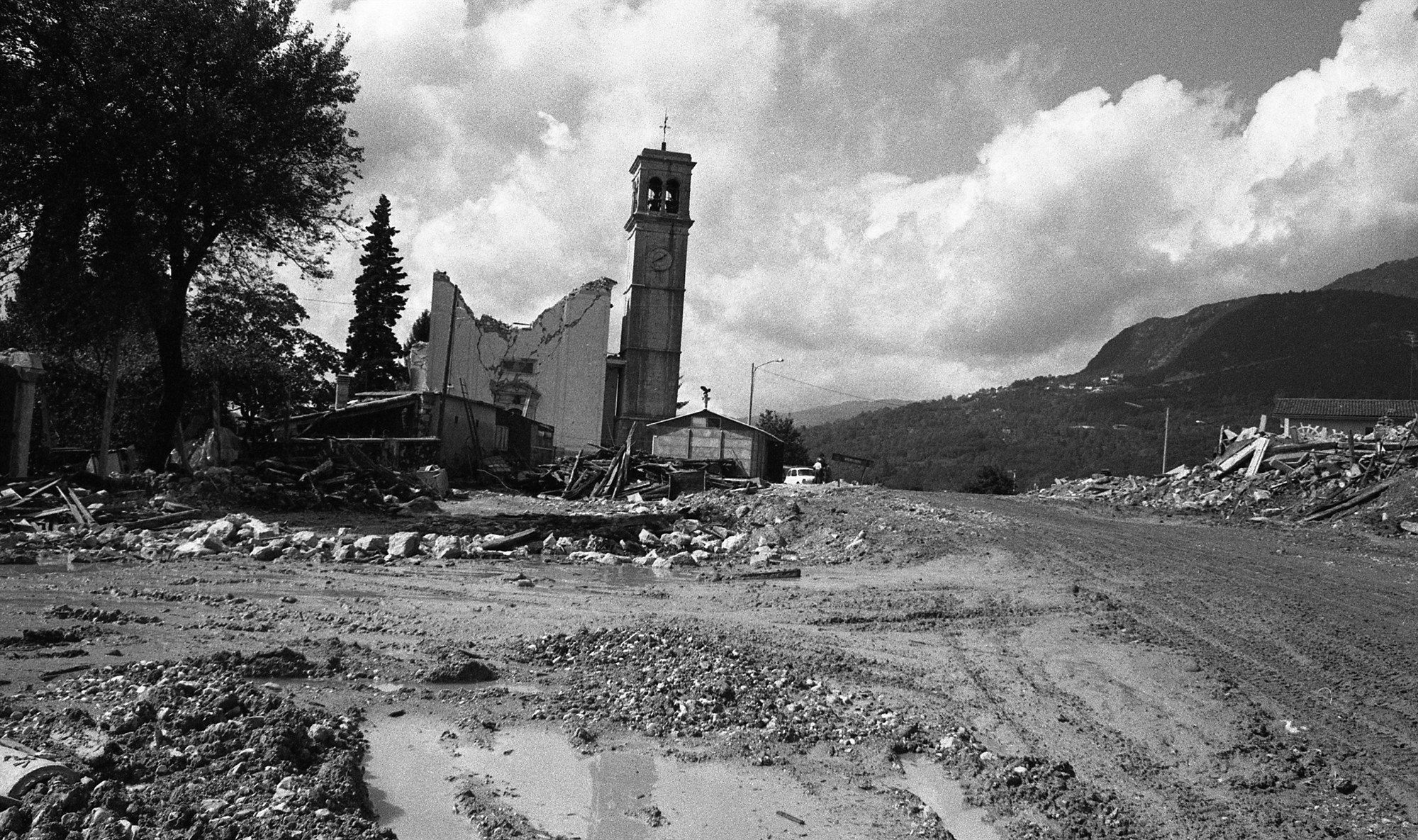
shaken by an earthquake on May 6 1976, many people still clearly remembered the
tremors of 1928 in Tolmezzo, which were felt in several valleys along the
tributaries of the Tagliamento River, as well as those of 1936 on the Cansiglio
plateau. The earthquakes of May 6 and September 15 occurred in the densely
populated and largely agricultural upper Friulian plain beyond Udine and on the
slopes of the Prealps surrounding it.
The
“Orcolat”, the “ugly ogre” from popular tradition, who is said to
dwell in the depths of the earth, caused almost one thousand deaths, destroyed
entire villages and disrupted the lives of tens of thousands of people.
Nevertheless, local and national communities ultimately rose to the challenge
of overcoming this tragedy. As with the two world wars, which had a profound
impact on this territory, the tragedy was transformed into an opportunity for
growth and innovation.